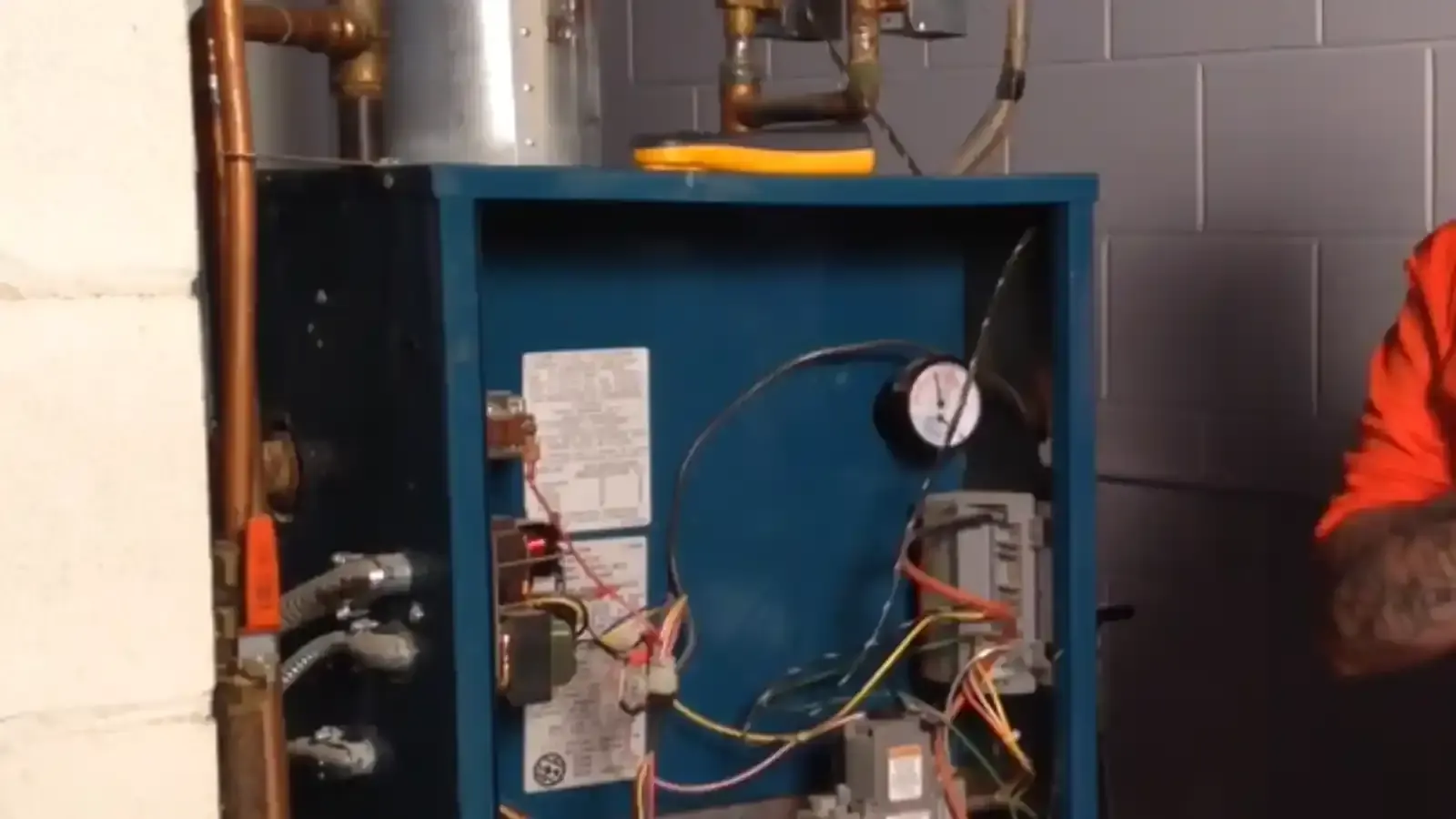
No heat tonight: the quick answer
If your boiler has stopped and the house is cooling, check three things in order: the thermostat setting, the power switch at the boiler, and the pressure gauge. If any of them is off or out of range, you may be able to restore heat without a visit. If they all look normal, call us.
Treat a gas smell, a yellow flame, soot around the boiler, or a carbon monoxide alarm as an emergency. Leave the house, then call the gas utility or 911 from outside. Do not try to relight anything or flip switches until a professional says it is safe.
Five minutes of checks before you call
- Thermostat.. Set it to heat and a few degrees above room temperature. Replace the batteries if the screen is blank.
- Boiler power switch and breaker.. Many boilers have a simple switch that looks like a light switch on or near the unit.
- Pressure gauge.. Compare the reading with the range printed on the gauge or the manufacturer label. Very low pressure often means a leak somewhere.
- Gas supply.. If you smell gas at any point, stop, leave, and call from outside. Never test for gas leaks with a flame.
- Water on the floor.. Note where it is coming from, shut the water feed to the boiler if you can reach it, and keep people away from the area.
Write down any error code on the display. It speeds up the call and helps us bring the right part.
What your boiler is telling you
These are common symptoms and how urgent they tend to be. Anything involving gas or carbon monoxide is always urgent.
| Symptom | Common cause | Urgency |
|---|---|---|
| No heat, no sound, no display | Power loss or blown fuse | Check power, then call same day |
| Radiators cold on upper floors | Air in the system or a failing pump | Call within the day |
| Kettling or banging noise | Scale, low water flow, or overheating | Shut down and call soon |
| Pressure drops again and again | A leak or a failing expansion tank | Call, possible water damage |
| Pilot or burner keeps going out | Ignition, flue, or gas valve problem | Urgent if any gas smell |
| Water pooling under the boiler | Failed fitting, relief valve, or heat exchanger | Shut off the feed and call now |
Heat out and nobody home to ask?
Call (440) 468-0237 any hour. Tell us the symptom and the pressure reading, and we will tell you whether it can wait until morning.
Hot water boilers versus steam: why it changes the repair
Most newer homes in this area use a hot water (hydronic) boiler that sends heated water through baseboard or radiant tubing. Older homes may have a steam boiler feeding radiators, and those have their own parts, such as a sight glass, a low water cutoff, and steam traps.
Tell us which type you have when you call. A steam boiler with a dirty glass and low water level needs a different fix than a hydronic boiler that lost pressure. The wrong guess can waste a trip, and a steam boiler run dry can damage itself quickly.
Frozen pipes are the next risk
A cold house with a dead boiler is a race against freezing. Keep the heat in by closing doors to unused rooms and keeping cabinet doors open under sinks on exterior walls. Let a faucet drip on the coldest wall and keep the main shutoff location in mind.
If a pipe has frozen or burst, shut off the main water valve first. Call us for burst pipe repair as soon as the boiler is stable, and do not use a torch or open flame to thaw copper or any pipe. Warm air from a hair dryer is the safer tool.
Why Solon boilers face a tough season
Cleveland Water says northern Ohio frost depth runs about three to three and a half feet, and the National Weather Service lists a January mean low of 22.3 degrees at Cleveland Hopkins airport. That is a Cleveland reading, not a Solon one, but it tells you how often a boiler here has to run through freezing nights. A system that is already weak will fail first on the coldest ones.
February 2015 was Cleveland's coldest February on record, with an average of 14.3 degrees and a low of minus 17 on February 20. If your boiler is old and you ever lose heat on a week like that, plan to have it looked at before the next freeze rather than after.
What a boiler repair visit includes
We start by confirming the symptom, reading the gauge, and checking the controls, the circulator pump, the ignition system, and the flue. The goal is to find the failed part and tell you what it is, not to start replacing things in hope.
If the repair is simple and the part is on the truck, it is done the same visit. If the part must be ordered, we explain the wait and what to do for heat in the meantime. Our boiler repair page lists what we service, and we say plainly if a unit is past worth fixing.
Repair or replace: a fair test
A single failed part on a boiler that has run steadily is usually worth repairing. Repeated failures, a cracked heat exchanger, a leaking sealed vessel, or constant pressure loss often mean the boiler is near the end of its life.
Ask for the reason in plain language and ask whether the problem will come back. A boiler that needs a new pump this winter and a new control board next winter costs more in repairs than one replacement. We will tell you the honest read, even if it means less work for us.
Pricing and who does the work
Boiler repair prices depend on the part, the type of boiler, how easy the unit is to reach, and whether the repair happens after hours. A pump swap is a different job than a gas valve or a heat exchanger. Parts availability and travel to the unit also matter.
We give a clear price before work starts, and we are licensed and insured. The Ohio Construction Industry Licensing Board licenses plumbing and hydronics contractors, and Solon requires contractors to register and show a current Ohio license. We serve Twinsburg and Bedford Heights homes too.
Boiler repair questions from Solon homes
Scale, trapped air, or low water flow can cause a banging noise. Shut the boiler off and call. Running it while it makes that sound can overheat the heat exchanger.
Only if the manufacturer's instructions say so and you smell no gas. If there is any gas smell, leave the building and call the gas utility or 911 first. When in doubt, call us instead.
It varies by boiler, so use the range printed on your gauge or the manufacturer's label. Pressure that is far below it or climbs high usually means a leak, a failing expansion tank, or a bad relief valve.
Yes. Our dispatch runs 24/7. Call (440) 468-0237, give the symptom and any gauge reading, and we will tell you what to shut off and whether a same-day appointment is available.
We can look at it. Steam boilers have different parts and risks, and some older units need parts that are hard to find. We will say plainly what is possible before work begins.
Close off unused rooms, open cabinets under sinks on exterior walls, and let a faucet drip on the coldest wall. If the house drops near freezing, shut the main water valve and call us.
Sources and standards behind this page
Local facts and rules on this page come from these public sources. Check the current version before relying on a permit or code detail.