No heat tonight: what to check and what to avoid
Some boiler faults are simple, and some are not. Start with safety, then try the easy checks.
- ✓Smell gas? Leave.Walk out of the house without touching switches, then call the gas utility or 911 from outside.
- ✓Check your carbon monoxide alarm.If it sounds, get everyone outside and call 911. Do not try to restart the boiler.
- ✓Look at the thermostat.Confirm it is set to heat, the batteries are fresh and the setting is above room temperature.
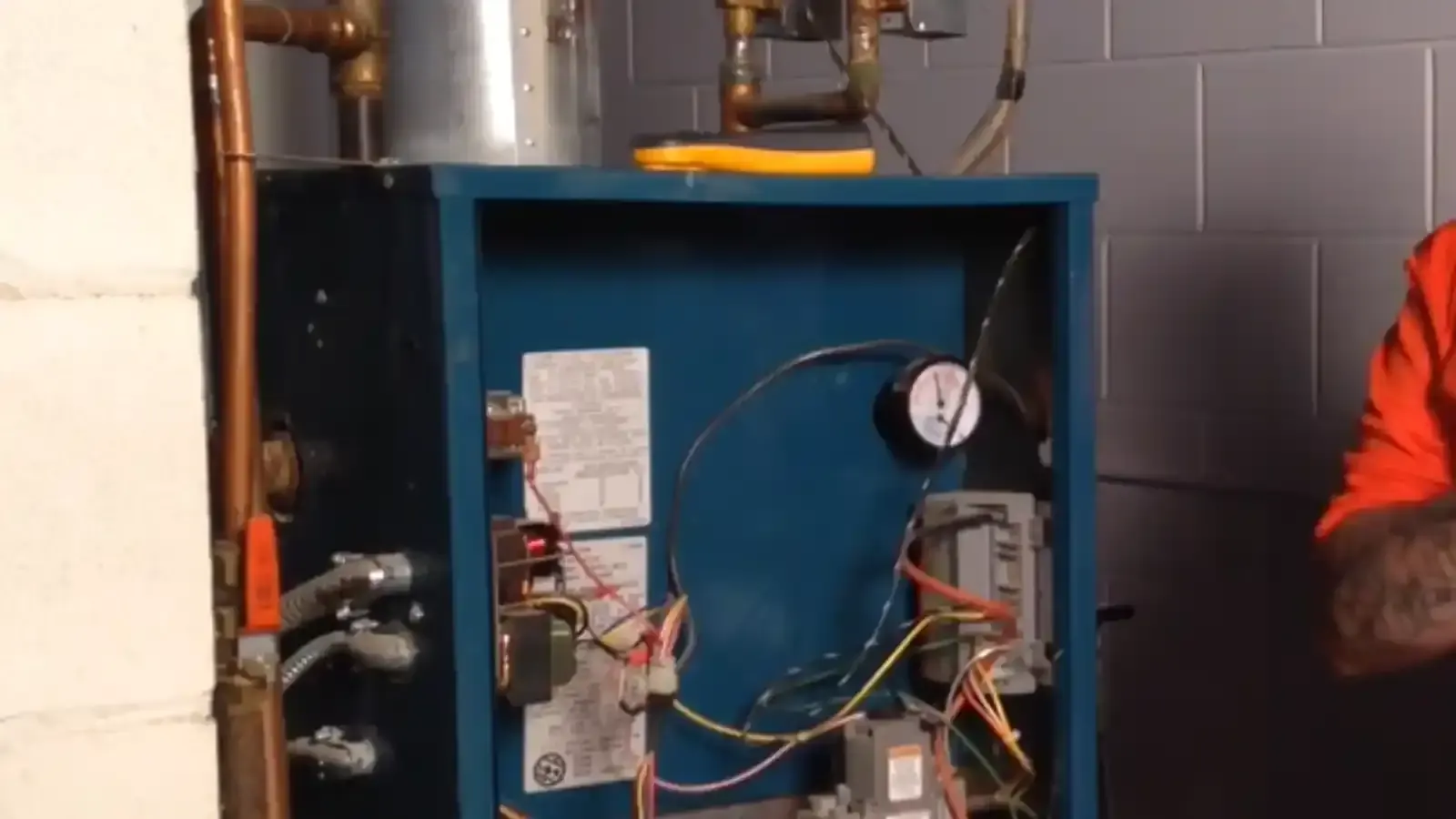
- ✓Read the pressure gauge.Most home boilers sit near the mid-range when cold. A reading near zero or in the red zone tells us what to bring.
- ✓Do not bleed or drain it yourself.Letting water out changes the pressure and can leave the boiler running dry.
Symptoms that point to a boiler fault
Cold radiators or baseboard
Air in the system, a failed circulator or a closed zone valve can stop hot water from reaching the rooms.
Banging or kettle-like noises
Mineral buildup or trapped air makes the heat exchanger noisy and signals it is working too hard.
Puddle under the boiler
A weeping valve, a failing tank or a leaking fitting. Leaks rarely fix themselves.
Pressure gauge dropping again
A slow leak, a worn expansion tank or a relief valve that is passing water.
Boiler cycles on and off
Short cycling can come from an oversized setting, a failing sensor or poor water flow.
Why a boiler fails in the middle of winter
Boilers run hardest when it is coldest, so weak parts get found out in the first deep freeze. A hot water boiler pushes heated water through pipes to radiators or baseboards, and it relies on a pump, valves, a pressure-regulated loop and a safe burner. Any one of those can fail without warning.
Cleveland Hopkins airport has a January mean low of 22.3 degrees Fahrenheit per the National Weather Service. A house that loses heat while pipes run through outside walls can freeze fast, so do not wait a day to see if the boiler starts again.
Heat out right now?
Call the dispatcher, say what the boiler and the gauge are doing, and we will line up a visit for the same day when we can, including nights and weekends.
From symptom to likely repair
This table shows how plumbers usually connect a symptom to its likely part.
| Symptom | Likely culprit | What happens next |
|---|---|---|
| Radiators cold, boiler hot | Circulator pump or air lock | Test the pump, purge air, replace if worn |
| No heat, pump silent | Power, thermostat or control board | Trace the signal from thermostat to boiler |
| Pressure keeps climbing | Failed expansion tank or fill valve | Check the tank charge and valve |
| Water on the floor | Leaking valve, fitting or tank | Locate the source and isolate |
| Rumbling noise | Scale or sludge in the system | Flush or clean the heat exchanger |
If the fault involves combustion or the gas train, we tell you plainly what we can repair and what needs a different specialist.
Permits and licenses to ask about in Solon
Solon requires contractors to register with the city each year and to show a current Ohio license before working. Ohio's Construction Industry Licensing Board licenses plumbing and hydronics contractors, and you can look up any contractor on the state's eLicense center before you hire. Doing that takes two minutes and tells you whether the person at your door is permitted to work.
The city's permit guide lists permits for plumbing installations and for replacing a water heater. It does not say how a boiler replacement is handled, so ask the Solon Building Department before a full replacement is booked.
How a boiler visit unfolds
- 1
Start with safety
We check for gas odor, carbon monoxide risk and visible leaks before we touch controls.
- 2
Trace the fault
We follow the call for heat from the thermostat to the boiler, check pressure and temperature, and look at pumps and valves.
- 3
Explain the repair
You see the failed part, hear whether repair or replacement makes sense and get a clear price before work starts.
- 4
Run it through a cycle
We fire the boiler, watch it reach temperature and confirm each zone is getting hot water.
A boiler is not a water heater
Plenty of people mix the two up. A water heater makes hot water for taps and showers, while a boiler heats water in a closed loop for the house. If you also need hot water repaired, read about water heater repair. If a burst pipe has soaked the boiler room, see burst pipe repair first.
What affects the price of boiler repair
Homeowners policies usually cover sudden, accidental water damage but not wear, neglect or the failed boiler itself. Check your policy, especially for freeze damage to pipes.
Boiler repair questions from Solon homes
Yes. Dispatch is open 24/7 and we book same-day visits when we can. Give the dispatcher the gauge reading and any leak or noise, so the crew arrives with likely parts.
Noise alone is not always dangerous, but it means something is off, like trapped air or scale. If you also smell gas or your carbon monoxide alarm sounds, leave and call 911.
Slow leaks, a failed expansion tank or a relief valve that passes water are the usual causes. Topping it up only hides the problem, so we trace where the water is going.
Most faults are repairable, such as pumps, valves and sensors. If the heat exchanger leaks or the unit fails repeatedly, we say so honestly and explain the replacement options. New piping or zone changes fall under plumbing installation.
Only if your water heater runs off the boiler. A separate tank is a different system, so we check how yours is set up when we arrive.
Use the Ohio Construction Industry Licensing Board's eLicense lookup. Solon also requires contractors to register with the city and show that license, so you can ask the Building Department.
Sources and standards behind this page
Local facts and rules on this page come from these public sources. Check the current version before relying on a permit or code detail.