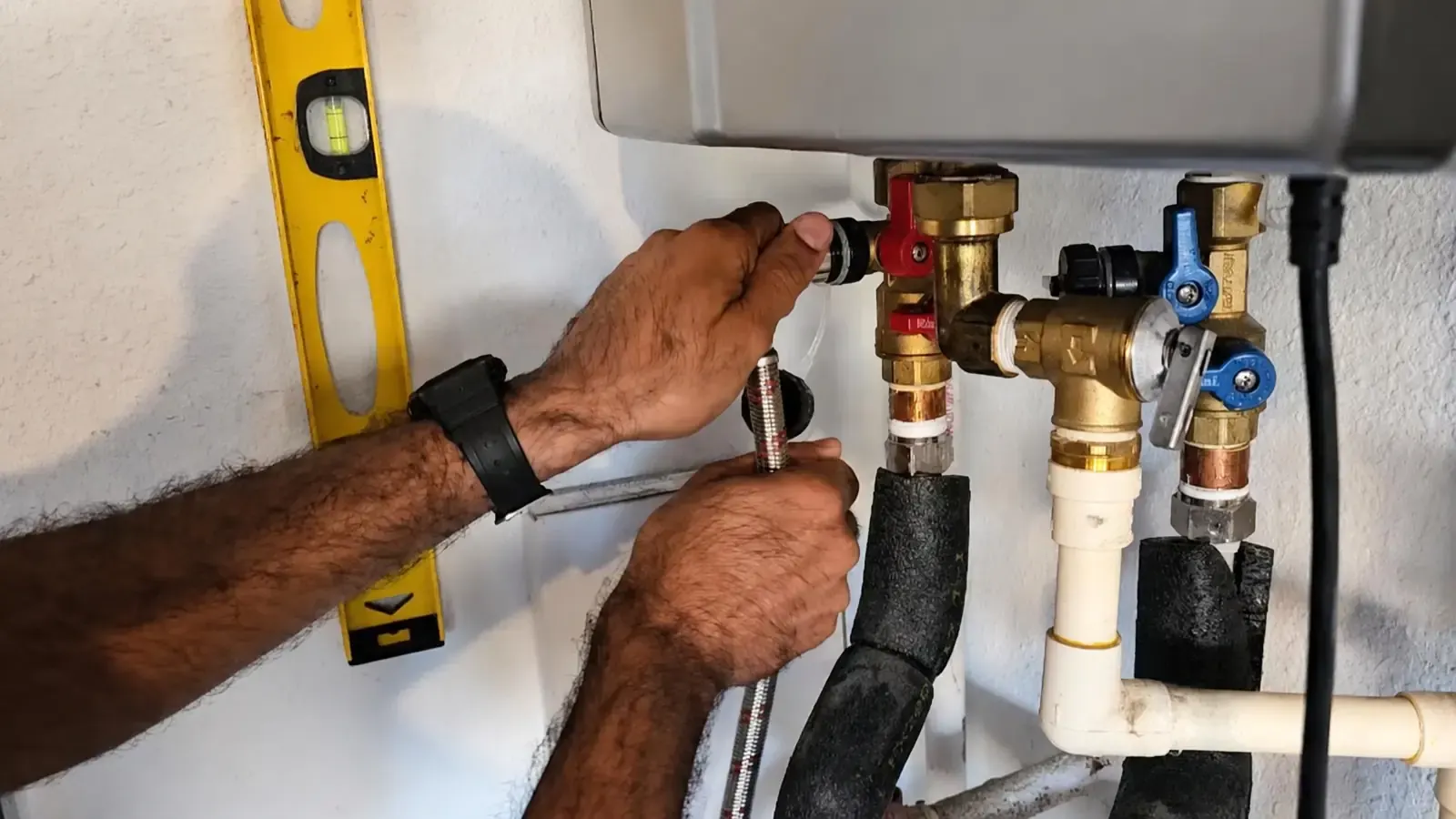
What scale does inside a wall-hung heater
A tankless unit heats water as it passes through a narrow metal heat exchanger. Minerals in the water come out of solution when heated and stick to the inside of that passage. Over months, the coating narrows the path and insulates the metal from the flame or element.
The result is predictable. The heater works harder for less hot water, flow drops at the tap, and temperature swings appear mid-shower. In the worst cases, the unit overheats and locks itself out with an error code.
Unlike a tank, nothing collects at the bottom for you to drain. The scale stays on the exchanger until something dissolves it.
Why Solon's water makes flushing a routine job
Solon is supplied by Cleveland Water, which describes its water as 7 grains per gallon, or 120 mg/L as calcium carbonate, classed as moderately hard. The 2025 Water Quality Report lists hardness between 105 and 130 ppm, averaging 117. A tankless heater here sees mineral-laden water every day.
Read your manual before you pick a schedule. Manufacturers set the flush interval, and some tie it to local hardness. Pair that guidance with the number above, and ask your plumber if you are unsure.
A flush is maintenance, not replacement. If the heater ever needs replacing, the city's Required Residential Permits Guide lists water heater replacement as a plumbing permit item.
Signs your tankless heater is overdue
| What you notice | What scale is doing | Does a flush help? |
|---|---|---|
| Hot water takes longer to arrive | Slows heat transfer | Often yes |
| Lukewarm output at full flow | Exchanger cannot keep up | Often yes |
| Display shows an error code | Overheat or flow sensor trip | Check the manual, then flush |
| Loud popping or kettling noise | Water boiling under scale | Yes, soon |
| Very low flow at every hot tap | Scale or a clogged inlet filter | Flush, clean the filter |
| Water leaks from the unit | Failed seal or cracked exchanger | No, call a plumber |
Error codes vary by brand. Look up your model's code before assuming scale is the cause, because some codes point to venting or gas supply.
What a flush involves
A proper flush needs isolation valves on the hot and cold lines, a small submersible pump, two hoses, and a bucket. The pump pushes vinegar from the bucket through the unit and back again. Without service valves, a plumber installs them first.
Most flushes circulate for about an hour, though your manual may call for a different time. After that, the unit is rinsed with clean water and the inlet screen is cleaned. The valves are then returned to their normal positions.
Never skip the rinse. Leftover vinegar in the lines tastes bad and can irritate seals if it sits.
Before you start a flush
Run through this list so nothing goes wrong mid-job.
- Read the manual.. Some makers specify the solution and the flush time. Use what the manufacturer says, not an internet recipe.
- Turn off power and gas.. Unplug the unit or switch off its breaker, and close the gas valve on a gas model.
- Look for service valves.. If your heater has no isolation valves, stop here. Cutting into the lines is a plumber's job.
- Smell gas? Leave.. Walk out and call the gas utility or 911 from outside. Do not turn anything on or off in the house.
- Keep the hoses clean.. Use hoses that have not touched chemicals or oil, since residue can end up in your hot water.
No isolation valves, or an error code you cannot read?
Call (440) 468-0237. A plumber can look at the model, add the valves, and run the flush in one visit.
Gas and electric units are different
Gas tankless units add a burner, a vent, and a gas line. Poor combustion air or a blocked vent can trigger shutdowns that look just like scale. A flush will not fix those.
Electric tankless units have heating elements instead of a burner. Scale builds on the elements, and a heavily scaled element can burn out. The flush steps are similar, but the breaker must be off the whole time.
Either way, venting and gas connections are a qualified plumber's work, not a weekend project.
Small habits between flushes
Clean the inlet screen when you flush, and check it again if hot water flow drops suddenly. Debris from a repair or a main break can clog it long before scale does. It is a thirty second job with a small brush.
Keep the area around the heater clear. Boxes stacked against a gas unit block combustion air, and dust in a garage can foul the fan. Look at the display once in a while too, since a stored code can warn you early.
What shapes the price of a flush
Cost depends mostly on whether the heater already has service valves. Installing them adds parts and labor, but it makes every future flush faster. The condition of the heat exchanger also matters, since heavy buildup takes longer to clear.
Access is another factor. A unit in a tight closet or high on a wall takes more time than one in an open garage. Ask for a price before work begins, and ask what is included.
When flushing is not enough
If the unit keeps throwing codes right after a flush, the problem lies elsewhere: a failed sensor, a bad igniter, or a cracked exchanger. At that point you need water heater repair rather than another flush.
If the heater is old and repairs are piling up, a new unit may be cheaper over time. See our tankless water heater page for repair, flush, and installation work.
We also serve nearby towns, including Aurora and Twinsburg. Call (440) 468-0237 to ask about a visit.
A note on insurance
Homeowners policies usually cover sudden, accidental water damage but not wear, neglect, or the failed part itself. Scale damage builds slowly, so it is usually treated as a maintenance matter. Check your policy.
Tankless flush questions
Follow the interval in your manual. Because Solon's water is moderately hard, many owners flush once a year. A plumber can adjust that based on how your unit performs.
If the heater already has isolation valves and you follow the manual, many homeowners can. If there are no valves or you smell gas, call a plumber.
A softener reduces scale but does not always remove it entirely. Keep up with the manual's schedule even with a softener, and ask your plumber how your setup performs.
The mild acid dissolves calcium and magnesium deposits on the heat exchanger. It then rinses out with the fluid. Some makers recommend a specific descaler instead, so check the manual.
A flush is maintenance, and the city's permit guide lists water heater replacement, not servicing. If the job turns into a replacement, ask your plumber about the plumbing permit.
It might be, but check for an error code, a gas or power fault, and a clogged inlet filter first. If those are fine, a flush is a reasonable next step.
Sources and standards behind this page
Local facts and rules on this page come from these public sources. Check the current version before relying on a permit or code detail.