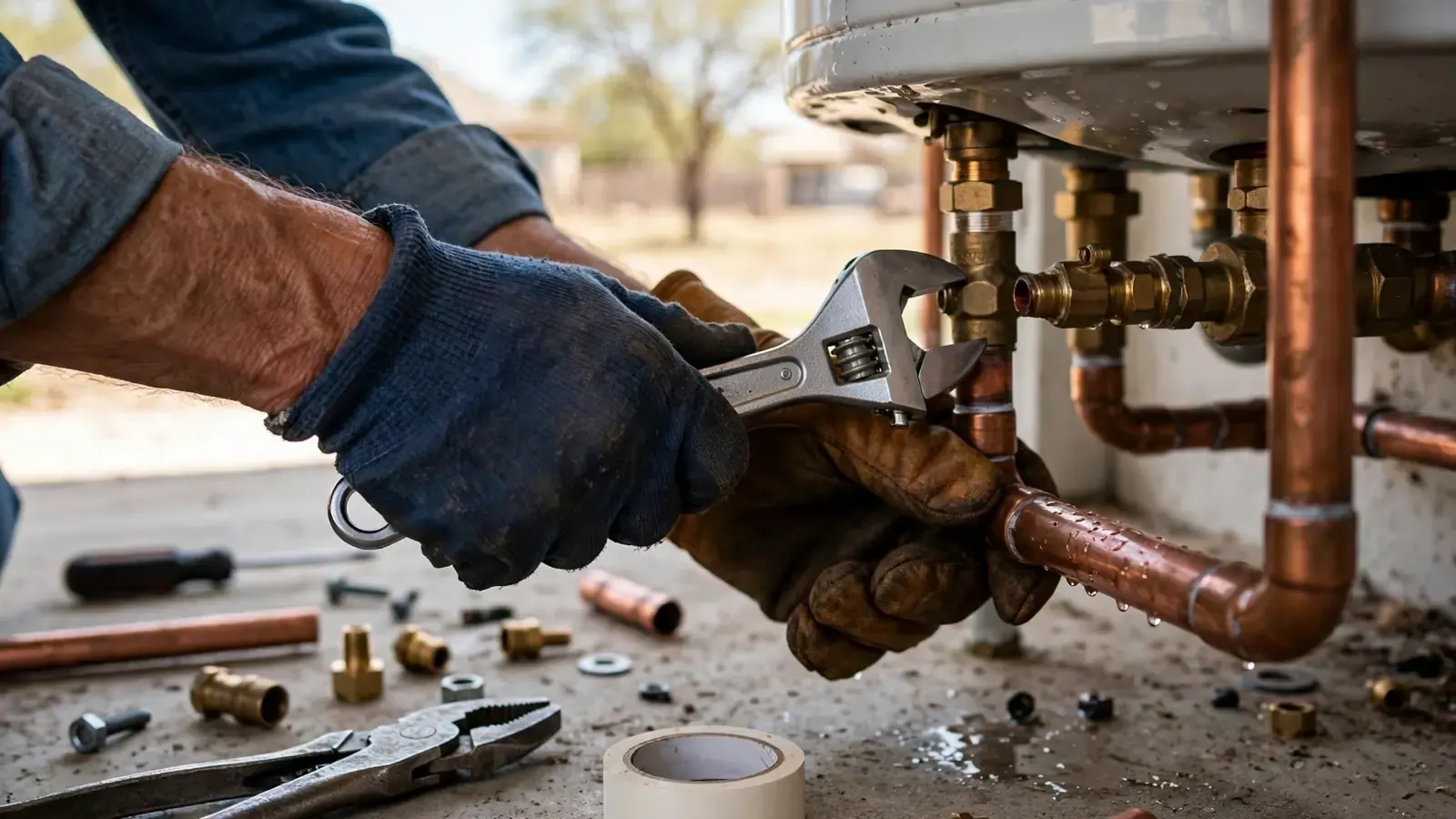
Find the real source before you decide anything
A puddle under the heater does not always mean the heater is leaking. Condensation on cold pipes, a furnace or air conditioner drain line, and a weeping washing machine hose can all drop water on the same floor. Dry the area with a towel and watch for a fresh drip over the next hour.
Look up first. Run a dry paper towel along the cold inlet pipe, the hot outlet pipe, and the shutoff valve above the tank. Wet spots there point to a fitting that can often be tightened or replaced without touching the tank itself.
Next, check the side of the tank near the top, where a discharge pipe from the relief valve runs down toward the floor. If that pipe is wet or dripping at the end, the valve has opened because of pressure or heat, or it has worn out. Either way, it needs a plumber soon.
Which leaks can be repaired and which cannot
Use this as a rough sorting guide. A plumber still has to confirm the source with the heater drained and dry.
| Where the water shows up | Likely cause | Usual outcome |
|---|---|---|
| Top of the tank, around the pipes | Loose or corroded supply connection | Often repairable on the spot |
| Pipe running down from the side valve | Relief valve opening or failing | Valve replaced, pressure checked |
| Low on the tank, at a small valve | Drain valve seeping | Valve replaced or capped |
| Bottom of the jacket or the drain pan | Tank wall has rusted through | Replacement needed |
| Rust streaks or beading along a seam | Internal corrosion working outward | Replacement needed |
If your row says replacement, a patch or a tube of sealant will not hold. Water pressure and heat cycles pull any repair loose within days.
What to do in the first ten minutes
Work in this order. Each step takes under a minute.
- Kill the heat source.. Switch off the breaker for an electric heater, or turn the gas control to pilot or off. If water is pooling and you cannot reach the breaker without stepping in it, stay back and call.
- Close the cold inlet.. The shutoff valve sits on the cold pipe above the tank. Turn the handle until it stops, and the refill stops with it.
- Open one hot tap.. Running a hot faucet upstairs lets pressure out of the system and slows a pressurized leak.
- Protect what is nearby.. Move boxes, set a bucket, and lay down towels. Take photos of the water and the heater for your insurer.
- Smell gas? Leave.. Walk out of the building and call the gas utility or 911 from outside before you do anything else.
Water on the floor and the tank still filling?
Call (440) 468-0237 and describe where the water is coming from. We will tell you what to shut off while a plumber heads your way.
The small parts behind most of the drips
Supply connections on top of the heater take a daily beating from heat. Flexible connectors and old threaded fittings weep first, usually as a slow drip that leaves a white or green crust. Replacing a connector is a short job when the shutoff valve above it still closes fully.
The relief valve is a safety device, and it should never be capped or plugged. If it drips constantly, the cause may be a worn valve, but it can also be thermal expansion or excess household pressure. A plumber needs to test which one before swapping parts.
The drain valve near the bottom is plastic on many heaters. It can crack or seep after it has been opened to flush the tank. A brass replacement is usually the fix, as long as the tank itself is dry and sound.
Why a rusted tank cannot be patched
Inside the outer jacket, a steel tank holds the water behind a thin glass lining. A sacrificial anode rod is supposed to corrode first so the steel does not. Once the rod is used up, rust attacks the steel from the inside.
When rust finally breaks through, water leaks into the insulation and runs down to the floor. By then the damage is already spread across the tank wall. A repair at one spot only moves the leak to the next weak spot.
What Solon's water and permit rules mean for your tank
Solon gets its water from Cleveland Water, which states that its water is 7 grains per gallon, or 120 mg/L as calcium carbonate. That is moderately hard. Minerals settle at the bottom of a tank over time, so a periodic drain-down is worth asking your plumber about before a small problem grows.
The city's Required Residential Permits Guide lists replacing a water heater as work that needs a plumbing permit. It does not require one for replacing fixtures. Ask your plumber up front who pulls the permit, and ask the Solon Building Department if you want to confirm.
Contractors working in Solon must register with the city and show a current Ohio plumbing license. Before any tank swap, ask for proof of both. The state keeps a public license look-up through the Ohio Construction Industry Licensing Board.
What shapes the cost of a leak call
Price depends first on the part that failed. A connector or valve is a small repair. A tank replacement involves a new heater, hauling away the old one, and reconnecting gas or electric lines.
Fuel type, tank size, and how easy the heater is to reach all change labor time. Venting repairs, a new drain pan, or updating old shutoff valves add to the total. A plumber should quote the full job before work begins.
A word on insurance
Homeowners policies usually cover sudden, accidental water damage but not wear, neglect, or the failed heater itself. Photos taken before cleanup help your claim, and your policy language decides the rest.
Choosing between a repair and a new heater
If the leak is at a fitting or valve and the tank is dry underneath, water heater repair is usually the sensible first step. If the tank body is wet, move straight to water heater replacement and skip the repair attempt.
Age matters too. A heater that has needed several repairs in a short span is telling you the tank is near the end. Putting money into a worn tank rarely pays back.
We serve homes across Solon and nearby towns, including Bedford Heights and Twinsburg. Call (440) 468-0237 any hour if water is spreading.
Questions about a leaking tank
It is urgent when water keeps spreading, when the leak is from the tank body, or when electric parts are near the water. Shut off the power and the cold inlet, then call. A slow drip at a fitting can wait for a same-day visit.
Short term, yes, if the leak is slow and the heat source is off or safe. But closing the cold inlet stops the leak while you wait, and that means no hot water. Most people prefer a dry floor.
The valve opens when pressure or temperature climbs too high, or when it has worn out. Thermal expansion in a closed system is a common trigger. A plumber should test the pressure before replacing the valve.
No. A tank that leaks through the wall has corroded from the inside, and patches fail under heat and pressure. Replacement is the only lasting fix.
The city's Required Residential Permits Guide lists replacing a water heater under plumbing permits. Ask your plumber who handles it, and call the Solon Building Department if you want to double-check the current rules.
Many policies cover sudden, accidental damage but not the heater itself or damage from long-term leaks. Read your policy or ask your agent, and take photos before you clean up.
Sources and standards behind this page
Local facts and rules on this page come from these public sources. Check the current version before relying on a permit or code detail.