Find where the water comes from before you fix anything
Basement water has only a few entry points. It seeps through the floor and wall joint, drips through cracks in the wall, comes up through the floor slab, or backs up from a drain. Each one has a different cure, and a fix aimed at the wrong one is money wasted.
Run a simple test. Tape a square of plastic wrap tight against a damp wall for two days. Moisture on the room side of the plastic means water is leaking through. Moisture trapped under the plastic means humid indoor air is condensing on a cool wall, and no waterproofing will cure that. A dehumidifier will.
Then watch the timing. Water that appears during or just after rain points to the outside of the house. Water that shows up on a dry day suggests a leaking pipe, a failed sump pump, or a high water table. Write down the date and the weather each time you see it.
The order that saves the most money
Start with the cheapest fix that stops the water, and move inward only when you must.
- Extend the downspouts.. Water dumped beside the foundation soaks straight down the wall. Run each downspout several feet out onto a splash block or a buried pipe that leads away from the house.
- Clean and reslope the gutters.. Clogged gutters overflow right at the wall. Clear them each fall and check that they pitch toward the downspouts.
- Fix the grading.. The soil next to the house should fall away from the wall. Add compacted soil where it has settled, and keep mulch and flower beds from trapping water against the foundation.
- Seal visible cracks.. A small crack in a poured wall can be injected from inside with a flexible sealer. Do this only after the outside water is under control, or the crack may reopen.
- Add an interior drain and sump.. If water still comes in, a drain channel along the footing and a sump pump give it a path out. This is the most dependable fix for a basement that floods in heavy rain.
What interior waterproofing actually involves
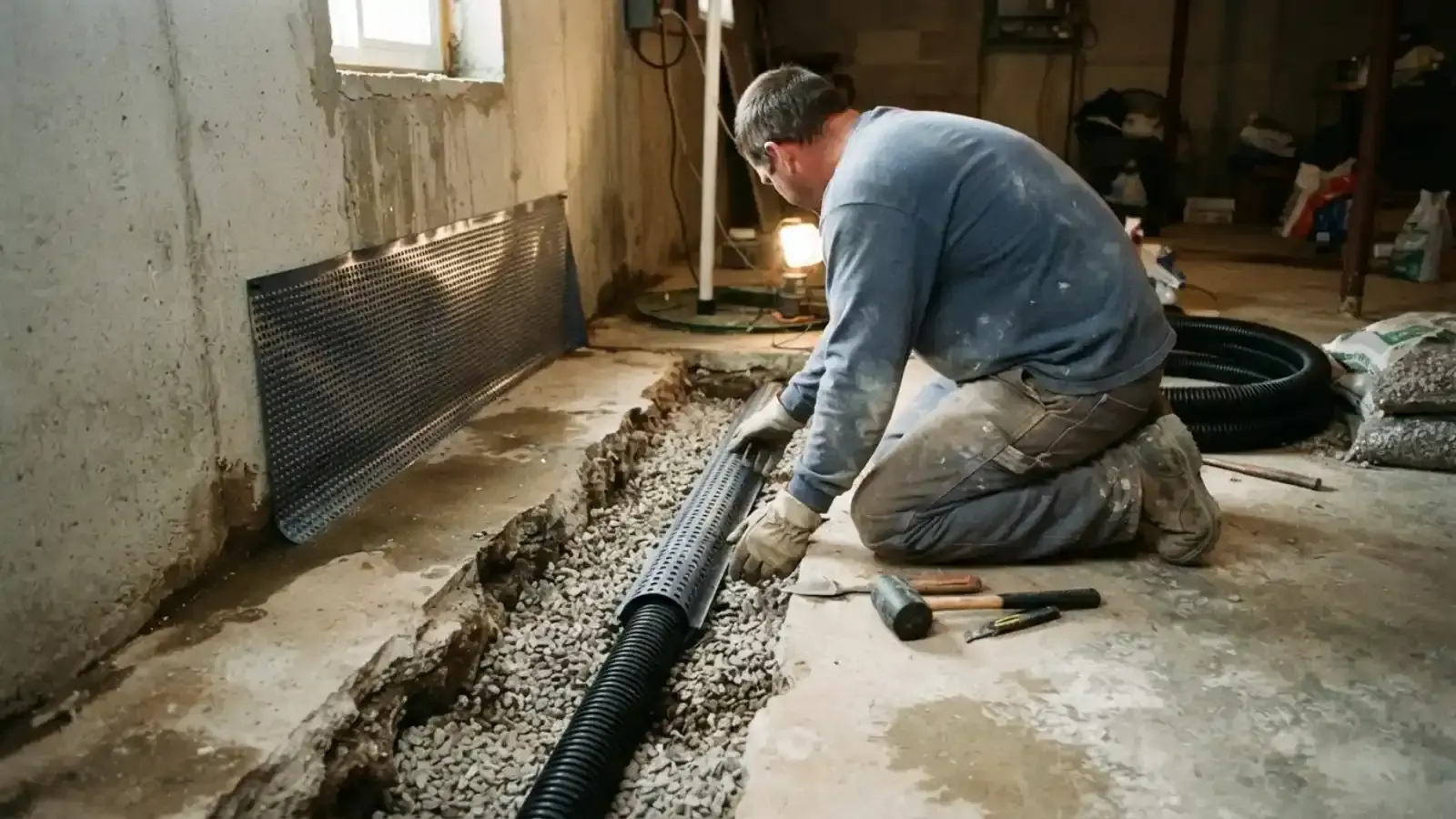
An interior system cuts a trench along the inside edge of the slab, removes a strip of concrete, and lays a perforated drain pipe in gravel. Water that reaches the footing flows into the pipe and runs to a sump basin. A pump then lifts it out and away from the house.
This approach does not stop water from touching the outside of the wall. It gives that water a managed place to go, so it does not rise over the floor edge. That is why it works well for the common problem of seepage at the wall and floor joint, and why it is the usual answer when outdoor fixes are not enough.
Paint-on coatings and sealers are a different story. A coating can slow damp-looking walls and hide light efflorescence, which is the white powder left by mineral salts. It cannot hold back real water pressure from behind the wall, and it often peels. If you see standing water, a coating is not the answer.
Outside work versus inside work
| Question | Exterior waterproofing | Interior drain and sump |
|---|---|---|
| Where the work happens | Digs out the soil along the foundation wall | Works from inside, with no yard excavation |
| What it does | Seals or membranes the wall and replaces the drain at the footing | Collects water at the footing and pumps it out |
| Mess and disruption | Disruptive to landscaping, patios and walkways | Disrupts the basement floor edge for a few days |
| Best for | Best when the wall itself is failing or you are already excavating | Best for seepage at the floor and wall joint |
| What to know | Needs a utility locate before any digging | Depends on a working pump and power |
Match the symptom to the likely fix
| What you see | Likely cause | Where to start |
|---|---|---|
| Wet floor only after hard rain | Roof and yard water reaching the footing | Gutters, downspouts and grading |
| Damp line along the base of the wall | Hydrostatic pressure at the floor joint | Interior perimeter drain and sump |
| Single crack that drips | Foundation crack | Outside water control, then crack injection |
| White powder on masonry | Mineral salts from moisture passing through | Find and reduce the moisture source |
| Water from a floor drain | Sewer or storm line backing up | Drain cleaning and a camera look |
| Water on a dry day | Plumbing leak or high groundwater | Leak check, sump pump test |
Solon rules that shape a basement drain job
Solon's municipal code, in the sewer chapter, says foundation drains shall not be tied into the sanitary sewer. The city also runs dye testing to find places where rain or groundwater improperly enters the sanitary system. For you, this means the footing drain and sump discharge must not be hooked to the sewer line, and any plumber you hire should tell you where the pump will discharge.
The city's stormwater page also encourages downspout disconnection and rain barrels, and notes that some projects may need a permit. We did not find a published Solon rule that spells out where a sump pump must discharge, so ask the city Building Department before you finish the plan. Before any outdoor digging, dial 811 at least two working days ahead. The call is free.
The role of the sump pump
A sump pump sits in a basin below the floor level and switches on when the water rises. It is the heart of an interior system, so the pump, the float switch and the discharge line all matter. A stuck float is one of the most common reasons a basement floods during a storm.
Test the pump at the start of spring and again in fall. Pour a bucket of water into the basin and watch it start, empty the basin, and shut off. If it hums but does not move water, or it cycles constantly on dry days, it needs attention. Our sump pump repair service covers float, check valve and discharge line problems.
A battery backup is worth a conversation. Storms often cut power at the exact moment the pump is working hardest. A backup pump runs on a deep cycle battery for a few hours and keeps the basin from topping over.
Dealing with a flood while you wait
If water is already coming in, safety comes first. Do not walk through standing water if the furnace, outlets or the electrical panel are in the basement, because the water may be energized. Shut the power off at the breaker only if you can reach the panel without stepping in water.
Move what you can to higher ground, and if the water is clean rainwater, start removing it with a wet vac or a pump. If the water smells like sewage, treat it as contaminated, wear gloves and boots, and call right away.
Our basement waterproofing team works from the cause to the cure. We can clear the floor drain, check the pump, and explain whether you need an outside fix or an interior system. We are licensed and insured, and you get the price before work starts.
Pictures help your plumber
Take photos of the wet area, the sump basin, and any stains on the wall with the date. Photos taken in the middle of a storm show exactly where water enters, which is hard to reproduce on a dry day.
Homes in the towns around Solon
Our crews also work on basements in Chagrin Falls and in Bedford Heights, where older homes often have older drains. The same order of fixes applies: outside water first, then the interior drain, then the pump.
Wet basement questions homeowners ask us
You can handle the outside steps yourself, such as gutters, downspouts and grading. Interior drains and sump systems involve cutting the slab and wiring a pump, so they are best left to a licensed plumber.
Not when water is entering under pressure. Masonry paint can cover damp stains, but it peels once real water pushes from behind. Fix the water source first.
Tape plastic wrap against the wall for two days. Moisture on the outside face of the plastic means condensation from room air. Moisture under it means water passing through the wall.
The city code says foundation drains cannot tie into the sanitary sewer, so the line must not go there. We did not find a published rule for the exact discharge point, so ask the city Building Department before you install.
Call if any digging happens outside. Ohio811 asks for notice at least two working days beforehand and the service is free. Interior work that stays inside the slab does not involve a utility locate.
Policies differ. Many cover sudden accidental water damage from a burst pipe, but treat groundwater and sewer backup as separate coverage. Read your policy or ask your agent before you file.
Sources and standards behind this page
Local facts and rules on this page come from these public sources. Check the current version before relying on a permit or code detail.